

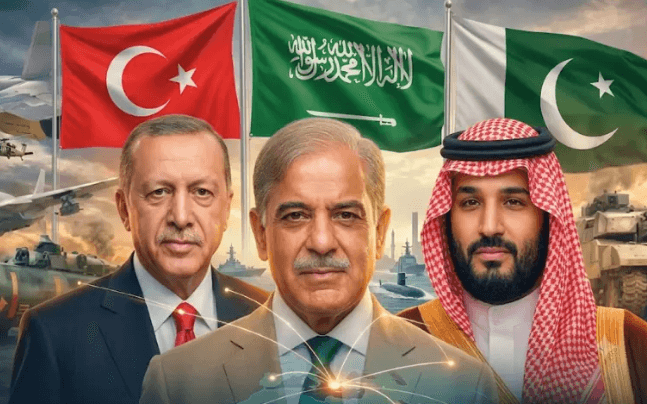
Prime Minister of Pakistan Committed to Saudi Arabia’s Security and Protection
(Asghar Ali Mubarak) The Prime Minister of Pakistan affirmed Pakistan’s steadfast, unconditional commitment to safeguarding Saudi Arabia’s security and territorial integrity. Pakistan, Saudi Arabia, and Türkiye concluded a joint defense agreement—the Makkah Joint Defense Pact—on August 7, 2026; it is based on the principle of “collective defense” (an attack on one is an attack on all), modeled after NATO’s Article 5. Following recent attacks by Houthi rebels, an emergency meeting of the Makkah Alliance was held in Riyadh, attended by Army Chief Field Marshal Syed Asim Munir, Defense Minister Khawaja Asif, and Deputy Prime Minister Ishaq Dar. The meeting resulted in a decision to immediately activate “collective defense measures.”
In a statement issued on Friday, the Government of Pakistan clarified that a significant number of its military personnel are deployed in Saudi Arabia, fulfilling defense-related duties. Three Saudi citizens were killed and several others injured in two separate attacks on the airport in Riyadh, the Saudi capital. According to reports, the Saudi General Authority of Civil Aviation stated that airport facilities were targeted in the first attack, which occurred yesterday. The Authority further reported that an aircraft belonging to the national airline was targeted during the second attack on Riyadh airport. According to the Saudi civil aviation authorities, a Saudi Airlines employee was killed in the attack on Riyadh’s King Khalid International Airport, and some of the injured are in critical condition. The national airline stated that there were no passengers on board the aircraft at the time of the attack; however, property damage was also sustained during the incident. Prime Minister Shehbaz Sharif has strongly condemned the Houthi militia’s attacks on Saudi Arabia, stating that Pakistan remains committed to safeguarding the Kingdom’s security, sovereignty, and territorial integrity, and stands shoulder-to-shoulder with the Saudi leadership and people during this difficult time. In his statement, the Prime Minister condemned the targeting of Riyadh and Abha airports and expressed regret over the casualties and injuries suffered by Saudi citizens. Commending the professionalism of the Saudi armed forces, Shehbaz Sharif noted that they played a vital role in saving innocent lives by intercepting multiple ballistic missiles. Pakistan’s Ministry of Foreign Affairs has officially confirmed the presence of Pakistani military contingents in Saudi Arabia. During a weekly news briefing in Islamabad, Foreign Office Spokesperson Sajjad Haider Khan stated that once the defense agreement becomes operational, the relevant authorities will make the necessary operational decisions themselves. The attacks on Saudi Arabia have been described as a matter of grave concern for Pakistan; the spokesperson noted that the appointment of the Secretary-General (Lt. Gen. (Retd.) Nauman Mahmood) under the defense agreement (Makkah Alliance) has been finalized, and all practical and operational decisions will henceforth be made by the relevant authorities. The balanced and positive role played by Pakistan amidst tensions or a potential conflict between the United States and Iran is being widely appreciated by the international community and foreign dignitaries.
The spokesperson stated unequivocally that, contrary to the allegations made by the Afghan interim government, the reality is that safe havens for the Tehreek-e-Taliban Pakistan (TTP) and the Baloch Liberation Army (BLA) continue to exist in Afghanistan. National security agencies are continuing their operations against elements that have taken up arms against the state, and all necessary measures are being taken to maintain law and order. Following the recent elections in Azad Jammu and Kashmir (AJK), the process of forming the new government has been successfully concluded. Earlier, the Director General of the Pakistan Army’s media wing (ISPR), Lieutenant General Ahmed Sharif Chaudhry, officially confirmed that Pakistan Army contingents are already present in Saudi Arabia under the Makkah Defense Pact. In an interview with the US broadcaster CNN, the DG ISPR clarified that the presence of troops under the Makkah Alliance is not a new development; rather, Pakistani military personnel have been serving in Saudi Arabia across various sectors and domains for decades. The Makkah Joint Defense Pact was concluded between Pakistan, Saudi Arabia, and Türkiye on August 7, 2026. The fundamental principle of this trilateral agreement is that an armed attack on any one of the three nations will be considered an attack on all of them (a provision modeled after NATO’s Article 5). Following recent attacks by Houthi rebels from Yemen on Saudi cities and installations, an emergency meeting of the Makkah Alliance’s Strategic, Political, and Defense Committee (SPDC) was held in Riyadh on October 5, 2026. During the meeting, Pakistan, Türkiye, and Saudi Arabia agreed to immediately activate “collective defense measures” to counter threats posed by the Houthi militia and to rapidly deploy agreed-upon military forces and capabilities to Saudi Arabia as required. Pakistan’s Chief of Army Staff General Syed Asim Munir, Defense Minister Khawaja Asif, and Deputy Prime Minister and Foreign Minister Ishaq Dar participated in this emergency session. The meeting also endorsed the nomination of Pakistan’s Lieutenant General (Retired) Nauman Mehmood as the first Secretary General of the Makkah Defense Alliance. According to the Pakistan Army spokesperson, Pakistan’s commitment to the security of Saudi Arabia and the protection of the Two Holy Mosques is unconditional; furthermore, this defense alliance is not a sudden development or one born of a vacuum, but rather a structured continuation of the longstanding historical, political, and military ties shared by the three brotherly nations.Earlier, Pakistan’s Federal Ministry of Information dismissed as fabricated a report in the American newspaper *The New York Times* regarding the use of Pakistan Air Force aircraft in operations against Houthi rebels in Yemen. The Ministry stated that the claims made in the report were incorrect and emphasized that international media should refrain from speculative reporting. This response from the Ministry followed a *New York Times* report claiming—based on information from a senior Pakistani military official speaking on condition of anonymity—that Pakistan Air Force fighter jets were being utilized in attacks against the Houthis in Yemen. The report also highlighted the intensifying conflict between government forces and Houthi militias in Yemen, particularly in the wake of recent explosions in the Saudi capital, Riyadh. Additionally, citing another Pakistani official, the report claimed that Pakistan’s role in the Yemen conflict was expected to be limited to providing air support rather than engaging in ground operations. Meanwhile, advising the international media to avoid speculation regarding the armed forces, the Ministry clarified that if any developments occurred in this regard, the relevant authorities would inform the media directly. It is worth noting that sounds of multiple explosions were heard in Riyadh on Thursday, though the cause of the blasts was not immediately clear. A day earlier, Saudi officials confirmed that three people were killed and dozens injured in attacks by the Houthi militia on two Saudi airports. According to Saudi officials, the Houthis targeted Riyadh’s King Khalid International Airport and Abha International Airport. The attack on Abha Airport resulted in the deaths of two women and injuries to 28 people, while a Sudanese national was killed and eight others were injured at King Khalid Airport. Houthi militia spokesman Yahya Saree claimed responsibility for the missile and drone attacks on both airports. On Wednesday, the Saudi-led military coalition fighting the Houthis claimed to have targeted dozens of Houthi military positions in retaliation for the attacks on the Saudi airports. According to the coalition, strikes against the Houthis destroyed missile stockpiles, key installations, and command centers. The Houthi militia currently controls most areas in northern Yemen, including the capital, Sana’a. During the recent conflict that began in July, the Houthis seized the entire Red Sea coastal region—previously held by the internationally recognized Yemeni government—last month. This week, the Yemeni government launched a major military operation against the Houthis dubbed “Operation Fajr al-Yemen” (Dawn of Yemen); the operation was formally announced on October 5 by Rashad al-Alimi, head of Yemen’s Presidential Leadership Council. The primary objective of this operation is to reclaim territories held by Houthi rebels and restore control over the country’s vital maritime routes and the capital, Sana’a. As a result of the renewed fighting in Yemen, more than 200,000 people have so far been forced to flee their homes. The United Nations has also described the current situation in Yemen as extremely dangerous and alarming. According to data released by the International Organization for Migration (IOM), a UN agency, a staggering surge in displacement has been observed across various Yemeni provinces due to an intensification of clashes during the first week of September. While the number of displaced persons stood at 76,000 by mid-September, it has since surpassed 200,000 in just a few days. The majority of those displaced left their homes for safer locations following the escalation of the situation in September. IOM Director General Amy Pope stated that people are being forced to abandon their homes to save their lives, yet, unfortunately, there is no suitable or safe place available for them. She has called upon the international community to provide emergency funding to address the growing need for food and shelter among the affected population. The report indicates that the displaced individuals hail from ten different governorates (provinces) of Yemen, with Taiz being the most severely affected. Additionally, more than 3,700 Yemeni citizens have migrated by sea to the African nation of Djibouti. According to the United Nations, tensions between Saudi Arabia—along with its allied forces—and the Houthis had largely subsided following the 2022 ceasefire in Yemen, but have now once again reached dangerous levels. The Houthi group currently controls most areas in northern Yemen, including the capital, Sana’a. Last month, the Houthis also seized the entire Red Sea coastal region that had been under the control of the internationally recognized Yemeni government. The Yemeni government launched a major military operation against the Houthis dubbed “Operation Fajr al-Yemen” (Dawn of Yemen); this was formally announced on October 5 by Rashad al-Alimi, the head of Yemen’s Presidential Leadership Council. The primary objective of this operation is to reclaim territories held by Houthi rebels.Since its establishment on August 7, 2026, the Makkah Defense Alliance has made rapid progress in strengthening its military strategy and institutional framework. Following the emergency meeting of the Strategic, Political, and Defense Committee (SPDC) held in Riyadh on October 5, 2026, the key outlines of the alliance’s military strategy are as follows:
1. Calibrated Defensive Response
According to Pakistani and Turkish military officials, the Makkah Alliance’s strategy is currently of a purely defensive nature.
• Avoidance of operations in Yemen: Military contingents from Turkey and Pakistan will not participate in any offensive or combat operations against Houthi rebels within Yemen.
• Objective and priority: The primary objective of the military strategy is solely to defend Saudi Arabia’s sovereignty, territorial integrity, and the Two Holy Mosques.
2. Rapid Military Deployment and Combat Readiness
During the emergency meeting, Pakistan, Saudi Arabia, and Turkey decided to immediately implement “collective defense commitments”:
• Pre-agreed military forces and capabilities will be rapidly deployed to Saudi Arabia in response to the threats it faces. • The provision of this military force will be carried out within the legal frameworks and national legislation of all three countries.
In accordance with the strategy finalized during the meeting of the three nations’ military chiefs (including Field Marshal Asim Munir) in Riyadh on September 25, 2026:
• Effective Intelligence Exchange: Strengthening legal frameworks and communication channels for the real-time sharing of intelligence regarding regional threats and missile/drone attacks.
• Military Integration: Enhancing the combat readiness of the three nations’ armed forces and their collective capacity to counter shared threats.
• Technical and Logistical Support: Türkiye and Pakistan are providing advanced weapon systems, air defense capabilities, and technical expertise to Saudi Arabia to enable it to effectively counter Houthi missiles and drones. Moving beyond mere political statements toward a tangible military structure, the Makkah Alliance has undertaken the following measures:
• Establishment of a Permanent Secretariat: A formal secretariat for the alliance has been established in Riyadh, Saudi Arabia.
• First Secretary General: Pakistan’s Lieutenant General (Retired) Nauman Mahmood has been appointed as the first Secretary General of the Makkah Defense Alliance for a three-year term, with operational authority vested in him.
• Joint Military Headquarters: A joint military and operational headquarters under the alliance is in the final stages of becoming operational; military personnel from all three countries will soon be deployed there. According to military analysts, the Makkah alliance has made significant organizational progress in a short period; however, several elements remain in the pipeline before it becomes a fully realized military entity:
• The alliance currently lacks a “permanent standing military force.”
• Finalization is still pending regarding a joint military commander, publicly defined rules of engagement, and a written military doctrine. The military strategy of the Makkah defense alliance aims to establish a robust “collective deterrent against aggression” in the region, ensuring that hostile elements recognize the strength of this tripartite force before contemplating a major attack on Saudi Arabia. Describing the Makkah joint defense pact as a guarantee of regional stability, General Ahmed Sharif Chaudhry noted that new security challenges have emerged in the region in recent years. He stated that the Makkah pact would serve as a joint defense force capable of thwarting any potential threat, establishing the principle that an attack on one member is an attack on all. The DG ISPR remarked that, given this arrangement, hostile elements would think twice before attempting to execute nefarious designs; the alliance’s purpose is not to label others as friends or foes, but rather to defend Saudi Arabia—a commitment that will be upheld. Efforts to end the Iran-US conflict and secure an agreement are ongoing and will continue; the goal is to reduce differences, achieve a peaceful resolution through dialogue, and prevent the conflict from escalating. He added that Pakistan played a pivotal role in facilitating a ceasefire between the US and Iran by maintaining neutrality, emphasizing that Pakistan’s interests lie in regional peace and stability, as no party stands to benefit from the further expansion of the conflict. The Government of Pakistan has clearly stated that a significant number of its military personnel are deployed in Saudi Arabia, performing defense-related duties.


