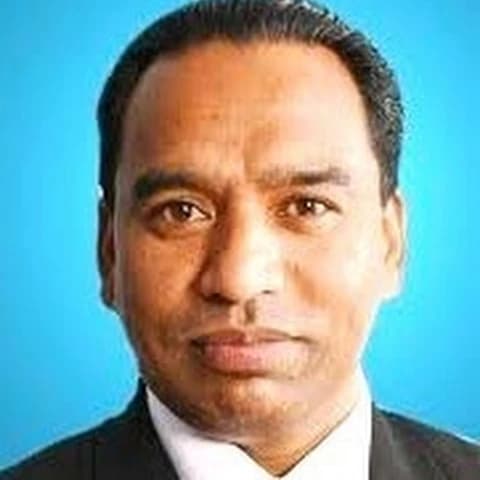


Super hero bus driver Meher Muhammad Khalil met Kumar Sangakkara, “We were thrilled to be here in Pakistan says, Marylebone Cricket Club (MCC) President
By;Asghar Ali Mubarak


The Super hero the bus driver Meher Muhammad Khalil, who turned Sri Lanka’s ‘hero’ in 2009 had the opportunity of meeting Marylebone Cricket Club (MCC) President Kumar Sangakkara in Lahore, Pakistan other day. Pakistani driver Meher Muhammad Khalil became a hero when militants attacked the Sri Lankan cricket team bus on a busy street in Lahore in 2009, holding his nerve under gunfire to whisk them to safety. The bus ambush, in which at least eight people were killed and eight wounded, including seven Sri Lankan players, drove cricket and most other international sports from Pakistan for years.
Khalil says the hype surrounding Sri Lanka’s return has sharpened his memories of the assault on the morning of March 3, 2009 as he drove the team to Gaddafi Stadium.Two elite police vehicles were in front of the bus as he eased on to Liberty roundabout in the heart of Lahore when Pakistani Taliban militants opened fire, spraying bullets along the convoy. “First I thought it was fireworks for our guest team,” he said, standing in the street where the ambush began. “Then a man came in front of me (and) fired straight at me with a Kalashnikov… I realised, it’s not fireworks.”The militants shot the drivers first, he said, killing the two in the lead vehicles on the spot. Khalil saw their vehicles skid one to the left and one to the right, opening a path down the centre – and then he hit the accelerator. “They fired intensely on the vehicle, and also lobbed a hand grenade and fired a rocket,” he said, but both missed.He does not remember hitting the brakes, he said, until he had driven the bus right inside Gaddafi Stadium.A security cordon was thrown up and he and the players stayed there until a military helicopter airlifted them right out from its grassy pitch.In the harrowing aftermath, Khalil was awarded medals and given cash prizes from grateful Pakistani and Sri Lankan officials.
The former Sri Lanka Captain and wicket-keeper batsman visited Pakistan leading a MCC Team during a series of T20 matches in Lahore. “I met Sangakkara at the Aitcheson College Grounds in Lahore before the match. It was my pleasure to meet the legend,” said jubilant Muhammad Khalil other day. I asked the captain for a selfie ‘’which he did ‘said ‘’ Meher Muhammad Khalil. Meher Khalil said, “I met Sangakkara at the Aitcheson College ground in Lahore before the match. It was my pleasure to meet the legend.” Incidentally, Sangakkara was a member of the squad which was attacked by the terrorist attack on 3rd March in 2009. “It was Sangakkara’s first visit after the incident and he did inquire about the country and wished me well. We are fortunate enough to have a great cricketer in our country and I am sure he will encourage the other countries to come and play here.” Meher Khalil had earned fame and success after saving Sri Lanka’s cricket team from a deadly 2009 attack in Pakistan. He was even invited by the Sri Lankan government and was accorded the VIP treatment during his stay in Sri Lanka. “I could not meet Sangakkara during my Sri Lanka visit but I had met him in South Africa when he toured with the team there. I was employed in South Africa for a short period,” Khalil added.
More over in December 2019, Sri Lanka toured Pakistan for 16 days and played test matches at Rawalpindi and Karachi. That was the first test series in Pakistan in more than a decade after a 2009 terrorist attack on the Sri Lanka cricket team bus at Lahore left eight people killed and injured several players. The ten-year hiatus was a hardship for cricket-mad Pakistan, and the resumption of international test matches on home soil in 2019 was roundly cheered. For many Pakistanis, it was a point of pride, proof that their country was becoming safe again after regular terrorist attacks. Pakistan’s Prime Minister Imran Khan, himself a former cricket star, personally welcomed the Sri Lankan team to Pakistan. A tally put together by Pakistani think tanks found terror attacks dropped from nearly 2,000 in 2009 to fewer than 250 in 2019. The drop was particularly noticeable after 2014, when a horrific attack on a school in Peshawar killed 150 people, including 134 children. The attack shocked the nation and galvanized a concentrated anti-terrorism campaign by the government, including military operations to root out militant groups in tribal areas.Mean while H.E.Dr Christian Turner, CMG, the British High Commissioner to Pakistan, paid a warm tribute to the Marylebone Cricket Club (MCC) and the Pakistan Cricket Board (PCB) for a successful tour to Pakistan. MCC, one of the world’s oldest cricket clubs, has been on a week-long tour to Pakistan. The High Commissioner hosted a reception to celebrate the collaborative efforts to bring international cricket back to Pakistan. The reception was an opportunity to show the warmth of enduring UK-Pakistan ties and the power of sport to strengthen people-to-people connections.At the reception, the High Commissioner showcased his cricketing skills by batting, bowling and keeping wickets with the cricket legend and MCC President Kumar Sangakkara. Senator Faisal Javed attended the reception on behalf of Prime Minister Imran Khan, and presented a bat signed by the PM to Sangakkara.The British High Commissioner H.E. Dr Christian Turner, CMG, said; “To welcome the world’s oldest and most famous cricket club is a sign of confidence in Pakistan, and of the improved security situation that led to the change in UK travel advice.’’Cricket is in our blood and one of the many bonds that binds us together. I hope it is a step to welcoming an England cricket team back to Pakistan.” On this occasion commenting on the tour, MCC President Kumar Sangakkara said:“We were thrilled to be here in Pakistan. The Pakistan Cricket Board has done a tremendous job in rebuilding the international cricketing landscape here, and for MCC to be touring the country is a momentous occasion for everyone involved.“The aim of the tour is to encourage international teams to visit Pakistan and we hope that this trip goes a long way to achieving that aim.”Also present at the reception were the MCC squad, Governor Punjab Chaudhry Muhammad Sarwar, members of the parliament, senior members of the PCB, Pakistan’s cricketing stars and the artists and influencers from the media industry. This mentioned here that the Pakistan cricket team is scheduled to tour England from July to September 2020 to play three Tests and three Twenty20 International (T20I) matches. The Marylebone Cricket Club (MCC) is a cricket club founded in 1787 and based since 1814 at Lord’s Cricket Ground, which it owns, in St John’s Wood, London.MCC are the custodians of the Laws of Cricket and are responsible for the debating, decision making and drafting of the Laws. It is one of the Club’s most important roles, having carried it out since formation.MCC plays more matches than any other cricket club – around 480 per year against schools, universities and clubs in the UK, and between 20 and 30 fixtures annually as part of its overseas touring programme, which aims to develop cricket abroad. On the international stage, MCC has a World Cricket Committee, currently chaired by Mike Gatting that contains eminent current and former players and administrators. It has a remit to act as an independent think tank debating issues and making recommendations about the health and state of the game, as well as to commission research.After the conclusion of the Marylebone Cricket Club’s week-long tour of Lahore, Kumar Sangakkara, the President of the prestigious MCC and captain of the club’s touring squad to Pakistan, has said that he would love if more international teams consider touring Pakistan so international cricket in the country can be resumed in full force.
The MCC arrived in Lahore on 13 February to play a 50-over and three T20-over matches. Over the course of their stay, the visitors explored the city by playing golf, visiting the historic Lahore Fort and enjoying dinners across Lahore.
Speaking to PCB Podcast, which is available here for free listening and downloading for editorial purposes only, the batting great said: “It’s been great to be back in Pakistan.
“It’s been a long time since I came here and it has been even longer for the MCC. For us, it has been about coming here and playing cricket in support of Pakistan’s journey of getting international cricket back.
“It’s important that, when you are in a country on a tour, you’re not confined to a hotel, but you can go around and enjoy the city and the country you’re in.
“It is excellent for us to get to the [Lahore] Gymkhana golf course quite a few times. The players absolutely loved it. We were hosted with some amazing hospitality and warmth.
“The message we will be taking back is about the warmth of the people, the welcome of the fabulous spectators who came to watch cricket, the passion the players and people have for it and our own experiences of playing here and traveling about in Lahore.
“We would love for teams to consider coming here so that international cricket can finally come back to Pakistan in full force.”
In the last three months, Sri Lanka have played two Tests – in Rawalpindi and Karachi – and Bangladesh have been here twice for a three-match T20I series and a Test in Rawalpindi. With the fifth edition of the HBL Pakistan Super League, commencing today, being hosted in Pakistan for the first time since the advent of the league, the MCC’s visit rubberstamps the country’s ability to host international cricket.
“It is important things are put into context, moves are made, minds meet and things are reconsidered because the message that we take back is that Pakistan is a great place to tour,” Sangakkara said.
“I remember all those matches that I’ve played here but it’s always special to come back and revisit it. We never expected such a big crowd for a first game against the Qalandars. When we got to the ground, we had almost 19,000 people, hungry to watch some cricket.
“We were really, really impressed and we’re very, very moved and we understand very, very easily how much passion there is and how the lack of international cricket is not a great thing for Pakistan, for the people, for the players and for the financial status of the PCB.”
Over the course of their matches – a one-dayer against Pakistan Shaheens and three 20-over-a-side contests against HBL PSL franchises Lahore Qalandars and Multan Sultans and domestic T20 champions Northern – the MCC have played against some of the most exciting prospects in Pakistan’s domestic circuit.
Sangakkara – who has 12,400 Test runs, the most for any Sri Lankan batsman – praised the young talent in country. “I think Pakistan cricket is in a very healthy state,” he said. “Pakistan has always produced exceptional cricketers, especially young cricketers with a lot of variety; really fast bowlers, really good batsmen, mystery spinners, wrist spinners, you name it. On this trip it was no different.
“There were so many players from the Qalandars’ side who were exciting and orthodox. In the Northern, the domestic T20 champions, you had exciting players. In the [Pakistan] Shaheens, you had some really good batsmen.”
There is a divide in the global cricket fraternity regarding the future of Test cricket and whether four-day Tests should replace five-day contests. When the question was put to Sangakkara, he said: “It doesn’t matter where you emotionally stand. Whether I love Test cricket? Yes, of course, without a doubt. It is my favorite format. Should it be five days? Yes, of course, it should be five days.
“But, the reality is slightly different here. And we need to ask how many Test matches really go into five days? How many people are now actually coming to the ground to watch five days of cricket? Or whether there is a realistic possibility into the future of them coming with the time constraints of a modern society?
“In certain countries we have the average age of a cricket fan of 45-plus which is not a healthy sign. It is a complicated thing on how we attract a cash-rich time-poor younger demographic of people and younger players to the game and also keep the established fans interested. It is a complicated thing.
“Day-night Tests have been mooted and various other innovations have been brought to keep the crowds in the stadiums for Test cricket.
“And, it is not just about the big sides that play, it has also been about the slightly lesser sides that have had the Test status. What does cricket mean for them? Five days of cricket for certain sides and four days for others, that’s not a healthy way to go forward either.
“It is debate that will go on for some time but the solutions have to be practical and equitable. It has to be fair to the spectators, to the sponsors, to the TV networks that bring in so much money into this sport and also to the players. So it is not an easy answer and a lot more thought has to go into it.”