
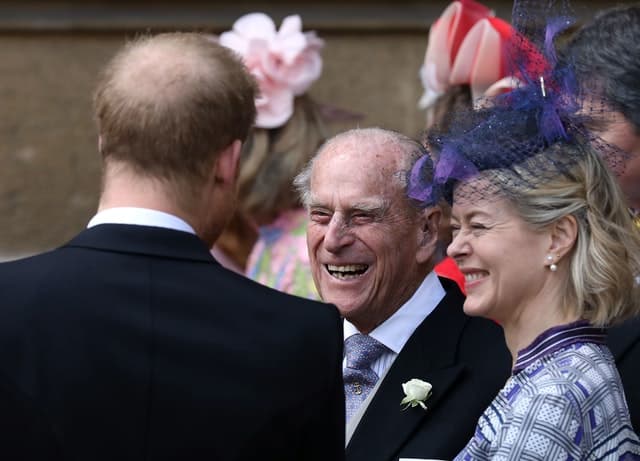
Prince Philip, Duke of Edinburgh praises key workers and those tackling corona virus pandemic
By;Asghar Ali Mubarak

The Duke of Edinburgh has made a rare public statement, praising those tackling the corona virus pandemic across the UK and keeping essential services running.
Philip, 98, who retired from public duties in 2017, said he wanted to recognize the “vital and urgent” medical and scientific work taking place.
In his message, the duke also gave thanks to key workers including those involved in food production and distribution, refuse collection and postal and delivery services. Philip’s statement, published on the royal family’s social media channels, said: “As we approach World Immunization Week, I wanted to recognize the vital and urgent work being done by so many to tackle the pandemic; by those in the medical and scientific professions, at universities and research institutions, all united in working to protect us from Covid-19.
“On behalf of those of us who remain safe and at home, I also wanted to thank all key workers who ensure the infrastructure of our life continues; the staff and volunteers working in food production and distribution, those keeping postal and delivery services going, and those ensuring the rubbish continues to be collected.” The message was signed off with “Philip”.
The duke is affiliated to more than 750 organizations, including the scientific, technological research, healthcare and infrastructure sectors which have been responding to the outbreak.
Philip, who turns 99 in June, has been staying with the Queen at Windsor Castle with a reduced household for their safety.
Buckingham Palace highlighted some of the organizations with links to Philip who are responding to the outbreak.
The duke has been an honorary fellow since 1969 of the Chartered Institution of Wastes Management.
The institution is supporting those working in the waste disposal sector, providing up-to-date guidance and matching resources and contractors during the outbreak.
The duke has also been patron of the London School of Hygiene and Tropical Medicine since 1952.
Its experts are involved in research, as well as providing guidance to those responding around the globe.
He is also a longstanding fellow of the Royal Society, which is working to identify the most important factors that can help slow the spread of the virus and find long-term solutions to the pandemic.
The Royal Academy of Engineering, of which Philip is a senior fellow, is supporting the Government to call on engineers to help NHS England continue to deliver front-line services, and develop new medical facilities.
When the Queen left Buckingham Palace for Windsor nearly five weeks ago, Philip also moved to the Berkshire castle from Wood Farm on the Sandringham estate, where he has spent most of his time since retiring. His grandson the Duke of Cambridge said on Friday that the royal family were doing “everything we can” to protect the duke and the monarch.
William said: “Obviously I think very carefully about my grandparents – who are the age they’re at, we’re doing everything we can to make sure that they’re isolated away and protected from this.
“But it does worry me, what’s going to happen to a lot of the vulnerable, high-risk people who are going potentially to have to isolate away for quite some time.”
The duke, who dedicated decades of his life to public service, retired in August 2017 and has rarely been seen in public since then.
The Queen celebrates her 94th birthday on Tuesday.
Prince Philip, Duke of Edinburgh (born Prince Philip of Greece and Denmark, 10 June 1921), is the husband of Queen Elizabeth II of the United Kingdom and other Commonwealth realms.
Philip was born into the Greek and Danish royal families. He was born in Greece, but his family was exiled from the country when he was an infant. After being educated in France, Germany, and the United Kingdom, he joined the British Royal Navy in 1939, aged 18. From July 1939, he began corresponding with the 13-year-old Princess Elizabeth, whom he had first met in 1934. During the Second World War he served with distinction in the Mediterranean and Pacific Fleets. After the war, Philip was granted permission by George VI to marry Elizabeth. Before the official announcement of their engagement in July 1947, he abandoned his Greek and Danish royal titles, became a naturalised British subject, and adopted his maternal grandparents’ surname Mountbatten. He married Elizabeth on 20 November 1947. Just before the wedding, he was created Duke of Edinburgh, Earl of Merioneth and Baron Greenwich. Philip left active military service when Elizabeth became queen in 1952, having reached the rank of commander, and was formally made a British prince in 1957.
Philip and Elizabeth have four children: Prince Charles, Princess Anne, Prince Andrew, and Prince Edward. Through a British Order in Council issued in 1960, descendants of the couple not bearing royal styles and titles can use the surname Mountbatten-Windsor, which has also been used by some members of the royal family who do hold titles, such as Princess Anne, and Princes Andrew and Edward.
A keen sport enthusiast, Philip helped develop the equestrian event of carriage driving. He is a patron, president, or member of over 780 organisations, and he serves as chairman of The Duke of Edinburgh’s Award for people aged 14 to 24.. He is the longest-serving consort of a reigning British monarch and the oldest ever male member of the British royal family. Philip retired from his royal duties on 2 August 2017, aged 96, having completed 22,219 solo engagements since 1952. Prince Philip of Greece and Denmark was born in Mon Repos on the Greek island of Corfu on 10 June 1921, the only son and fifth and final child of Prince Andrew of Greece and Denmark and Princess Alice of Battenberg. A member of the House of Schleswig-Holstein-Sonderburg-Glücksburg, itself a branch of the House of Oldenburg, he was a prince of both Greece and Denmark by virtue of his patrilineal descent from George I of Greece and Christian IX of Denmark, and he was from birth in the line of succession to both thrones; the 1953 Succession Act removed his family branch’s succession rights in Denmark. Philip’s four elder sisters were Margarita, Theodora, Cecilie, and Sophie. He was baptised in the Greek Orthodox rite at St. George’s Church in the Old Fortress in Corfu.
Shortly after Philip’s birth, his maternal grandfather, Prince Louis of Battenberg, then known as Louis Mountbatten, Marquess of Milford Haven, died in London. Louis was a naturalised British citizen, who, after a career in the Royal Navy, had renounced his German titles and adopted the surname Mountbatten—an Anglicised version of Battenberg—during the First World War, owing to anti-German sentiment in the United Kingdom. After visiting London for the memorial, Philip and his mother returned to Greece where Prince Andrew had remained behind to command an army division embroiled in the Greco-Turkish War (1919–1922).
The war went badly for Greece, and the Turks made large gains. On 22 September 1922, Philip’s uncle, King Constantine I, was forced to abdicate and the new military government arrested Prince Andrew, along with others. The commander of the army, General Georgios Hatzianestis, and five senior politicians were executed. Prince Andrew’s life was believed to be in danger, and Alice was under surveillance. In December, a revolutionary court banished Prince Andrew from Greece for life. The British naval vessel HMS Calypso evacuated Prince Andrew’s family, with Philip carried to safety in a cot made from a fruit box. Philip’s family went to France, where they settled in the Paris suburb of Saint-Cloud in a house lent to them by his wealthy aunt, Princess George of Greece and Denmark.
Because Philip left Greece as a baby, he does not speak Greek. In 1992, he said that he “could understand a certain amount”. Philip has stated that he thought of himself as Danish, and his family spoke English, French, and German. Philip, who in his youth was known for his charm, was linked to a number of women, including Osla Benning.