

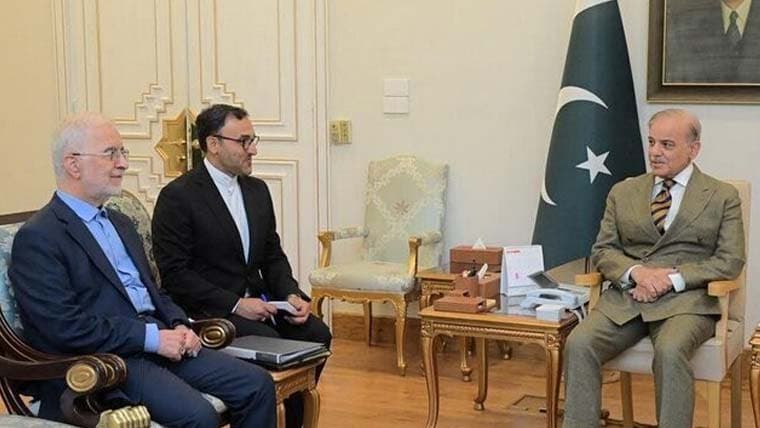
US-Iran peace process: Iranian minister meets Pakistani military and political leaders
—(Asghar Ali Mubarak) Pakistan’s mediation to prevent a direct war between the US and Iran has reached a critical juncture. The historic ‘Islamabad Memorandum of Understanding’ (Islamabad MoU), reached on June 17, 2026, through the efforts of Pakistan and Qatar, was suspended in early July after renewed attacks by the parties. Pakistan, however, has not given up on the diplomatic front and is working to revive the peace process. According to the Prime Minister’s Office, Prime Minister Shehbaz Sharif expressed deep concern over the recent military tensions between the US and Iran in the Gulf. He urged all parties to exercise restraint and avoid actions that could further destabilize the region. The Prime Minister reiterated that Pakistan is fully committed to continuing its constructive role as an “honest and sincere mediator and facilitator” for peace and stability in the region.
Iranian Interior Minister Eskandhar Momeni highly appreciated the tireless diplomatic efforts of Prime Minister Shehbaz Sharif, Deputy Prime Minister Ishaq Dar, and Field Marshal Syed Asim Munir, which resulted in the signing of the landmark ‘Islamabad Memorandum of Understanding’ between the US and Iran. The Iranian Interior Minister is accompanied by a delegation comprising senior officials from Customs, Agriculture, Transport, and the National Iranian Oil Company. Discussions were held on strengthening border infrastructure and transit links to increase the current annual trade between the two countries from $3 billion to $10 billion in light of the directives of Iranian President Masoud Peshmerga. Prime Minister Shahbaz Sharif conveyed his best wishes to the current leadership of Iran (President Masoud Peshmerga), recalling his visit to Tehran earlier this month and his attendance at the funeral of the late Supreme Leader Ayatollah Seyyed Ali Khamenei. Iranian Interior Minister Eskandar Momeni thanked the Prime Minister for the warm welcome in Islamabad and conveyed the best wishes of the Iranian leadership. He said that he had come to Pakistan with a delegation of high-ranking government officials to further strengthen the relations between the two countries.
The main objective of the meeting between Field Marshal Syed Asim Munir and Iranian Interior Minister Eskandhar Momeni is to reduce the recent tension between the US and Iran and advance the peace process.
Pakistan’s military and political leaders played a key role in brokering an interim agreement between the US and Iran last month. The Iranian interior minister highly appreciated Pakistan’s indispensable diplomatic role and sustained efforts to reduce the recent tension in the region.
Efforts are underway to bring Iran and the US back to the table under a joint proposal presented by Pakistan and Qatar. The US has also indicated that it is ready for real and serious negotiations.
According to the Inter-Services Public Relations (ISPR), matters of mutual interest, the regional security situation, and effective border management between the two countries were discussed in detail during the meeting. The two leaders reaffirmed their commitment to maintain close contacts and mechanisms of mutual cooperation for the protection of regional security and mutual prosperity. Before arriving at GHQ, Iranian Interior Minister Eskandar Momeni also called on Prime Minister Shahbaz Sharif in Islamabad, where he conveyed a special message from Iranian President Masoud Peshmerga. The Prime Minister also agreed to further strengthen Pak-Iran relations and maintain close ties between the two countries. According to the Inter-Services Public Relations (ISPR), the regional and bilateral security situation was discussed during the meeting between Field Marshal Syed Asim Munir and Iranian Interior Minister Eskandar Momeni. Issues related to effective border management were discussed during the meeting. The Iranian Interior Minister appreciated Pakistan’s continuous efforts and indispensable diplomatic role in reducing regional tensions. According to the ISPR, the Iranian Interior Minister appreciated Pakistan’s efforts to encourage de-escalation and serve as a peace advocate. According to the ISPR, the meeting reaffirmed the commitment to maintain close coordination and cooperative mechanisms for the protection of regional security and mutual prosperity.The ‘Islamabad Memorandum of Understanding’ is a historic 14-point peace agreement between the United States and Iran, signed on June 17, 2026. The main objective of this agreement was to end the direct US-Iran war that began in early 2026 and the military tensions in the Gulf. Pakistan, along with Qatar, played the role of the central mediator in this peace process. After prolonged diplomatic efforts by Prime Minister Shahbaz Sharif, Field Marshal Asim Munir, and Deputy Prime Minister Ishaq Dar, US President Donald Trump and Iranian President Masoud Peshmerga signed the memorandum electronically. Ceasefire: Immediate and permanent cessation of military operations on all fronts (including Lebanon). Opening of the Strait of Hormuz: Iran assured the immediate opening of the Strait of Hormuz to restore international commercial shipping. Ending of naval blockade: The US announced the end of its severe naval blockade of Iranian ports. Financial relief and funds: The US issued a 60-day license for the recovery of Iran’s frozen assets and the sale of oil. Nuclear program: The start of talks on Iran’s uranium enrichment issues under the supervision of the International Atomic Energy Agency (IAEA). Future framework: The parties were given 60 days to reach a final peace agreement. Just a month after the agreement, in July 2026, this memorandum of understanding fell into a serious crisis and has been effectively suspended: Iran’s announcement: On July 18, 2026, Iran’s Deputy Foreign Minister officially announced the suspension of all its obligations under the Islamabad Memorandum. Iran’s position is that the United States has broken the agreement itself by continuing to attack Iranian defense facilities. US position: President Donald Trump has also declared the truce over in his statements. Strait of Hormuz closed again: After the resumption of military clashes and attacks between the two countries, the Strait of Hormuz has been closed once again, which has increased crude oil prices in the global market. Pakistan’s current position: Despite the suspension of the agreement, according to the Foreign Office of Pakistan, the Pakistani leadership has not yet given up on this mediation. The recent visit of Iranian Interior Minister Eskandar Momeni to Islamabad (July 2026) is also a link in this series, where Pakistan and Qatar are trying to bring the parties back to the basic outline of the ‘Islamabad Memorandum of Understanding’ through behind-the-scenes diplomacy. Pakistan and Qatar have presented a new joint proposal to Tehran and Washington, under which both countries have been asked to return to the position before July 9 so that the stalled talks can resume. This new proposal recommends a temporary 2-week ceasefire to immediately stop the ongoing air and naval attacks between the two countries. According to the proposal, Iran will reopen the trade routes of the Strait of Hormuz for 10 days, while the US will suspend the naval blockade of Iranian ports and the current sanctions on oil sales. Iranian Interior Minister Eskandar Momeni arrived in Islamabad carrying a special message from Iranian President Masoud Peshmerga. He held important meetings with Field Marshal Syed Asim Munir and Prime Minister Shahbaz Sharif. According to the ISPR, the Iranian delegation highly appreciated Pakistan’s “indispensable and consistent diplomatic role” in reducing tensions and bringing peace to the region. Iran has expressed its willingness to use Pakistan’s mediation again for indirect contacts between Tehran and Washington. The Iranian Foreign Office has made it clear that a renewed war between the US and Iran is not in anyone’s interest and could push the entire region towards destruction. The Foreign Office spokesperson clearly stated in a press briefing that “the impression that Pakistan has given up efforts is not correct. At present, the security environment is dominated by military tension, but the Islamabad Memorandum of Understanding is still the only viable framework for future peace talks.” Pakistan’s military and political leadership is currently pursuing extreme “defensive diplomacy” to ensure the security of its 900-kilometer border with Iran and to protect Pakistan from the effects of this major Gulf war.The tension between Iran and the United States in the Middle East has once again entered a very dangerous and strategic crisis that has seriously threatened the peace and stability of the entire region. During the military operations and intense air and naval attacks that have been ongoing for the past twelve days, the United States is targeting those Iranian targets, installations, and infrastructure that were protected until recently due to Pakistan’s dynamic diplomatic efforts. The strategic balance that Islamabad established between Tehran and Washington through backdoor diplomacy to save the region from a terrible catastrophe has been completely destroyed due to the intensity of the recent attacks and geopolitical tensions. This situation has not only brought the two powers to a major confrontation but has also caused irreparable damage to all those diplomatic means that were helping to maintain peace in the region until now. Tehran’s top military and political leadership is expressing strong distrust of Washington’s military actions, which seem to be blocking all avenues for negotiations and diplomatic efforts. In response to the US attacks, Iran has announced that it will effectively suspend the Islamabad Memorandum of Understanding, block the Strait of Hormuz, and stop ships passing through it. The blockade of the Strait of Hormuz is not only expected to affect the supply of oil and LNG worldwide, but it is also creating a new and severe energy crisis in the global market. In response to the US advances and sanctions, the biggest targets of Iran’s war strategy are becoming the countries of the Middle East, especially Jordan, Bahrain, Kuwait and Saudi Arabia. During this ongoing tension, Iran’s attacks on the highly sensitive facilities that make seawater drinkable (desalination plants) have put the Gulf region in extraordinary danger. Kuwait has recently accused Iran of directly targeting the country’s major water plant for the second time, raising serious concerns about the supply of clean drinking water and human safety in the entire Gulf region. According to the Gulf Research Center, the extremely limited natural water available underground and desalination plants that purify seawater and make it drinkable together provide about 90 percent of the water supply and daily needs of the entire region. Due to global climate change, a huge increase in temperature and a decrease in groundwater levels in recent years, more than 400 water plants are active along the entire Gulf belt from the United Arab Emirates to Kuwait, which provide water to millions of residents and industrial sectors in this driest, hottest and most arid region in the world. The six member states of the Gulf Cooperation Council, including Saudi Arabia, the United Arab Emirates, Kuwait, Qatar, Bahrain and Oman, have a 60 percent global seawater desalination capacity. Kuwait, Oman, Saudi Arabia, and the United Arab Emirates get 90 percent of their drinking water, 86 percent of their water, 70 percent of their water, and 42 percent of their water from these plants. This is why attacks on these plants are creating a terrible economic, humanitarian, and environmental crisis, putting the lives of millions of innocent civilians at risk. In this worrying scenario, Kuwait, despite its long-term conventional defense agreement with the United States and the presence of the American security umbrella, is interested in utilizing the broad-based model of military cooperation established over decades between Pakistan and Saudi Arabia. According to a report by the international news agency Reuters, the framework of the Pak-Kuwait talks includes military training, joint exercises, transfer of defense technology, air defense support, drone security, intelligence, and exchange of high-level military delegations to create a sustainable, credible, and comprehensive strategic framework. Although there is a framework for limited military cooperation between the two countries since 2023, Kuwait is keen to expand it into a robust security framework in the light of current threats. The impression is that it wants to rely on the military experience of the Pakistani forces to protect its borders and airspace, but Pakistan has not yet announced any formal defense and combat agreement in this regard.
For Pakistan, the security situation in the Middle East is nothing less than a very complex diplomatic test. On the one hand, Islamabad is condemning in the strongest terms the attacks on civilian populations and economic infrastructure of Saudi Arabia and other Gulf states and is constantly convincing Tehran through diplomatic channels that attacks on Gulf installations will irreparably increase regional tensions, and this will harm the Muslim world. Although a few months ago, as a result of Pakistan’s mediation and diplomatic pressure, Iran had officially assured that it would not directly attack Saudi Arabia, the situation has become more exciting and unpredictable due to US attacks, Tehran’s hardline policy, and the new alignment of the region, the Houthi rebels, and other Iranian actions. Pakistan has always maintained that mutual conflict between Muslim countries will only strengthen the strategic interests of imperialist and hostile powers, which will weaken all regional Muslim countries economically and politically. Islamabad has maintained a very cautious, far-sighted and neutral diplomatic balance in all difficulties and crises and is reluctant to make itself part of any one bloc.


